People and Places
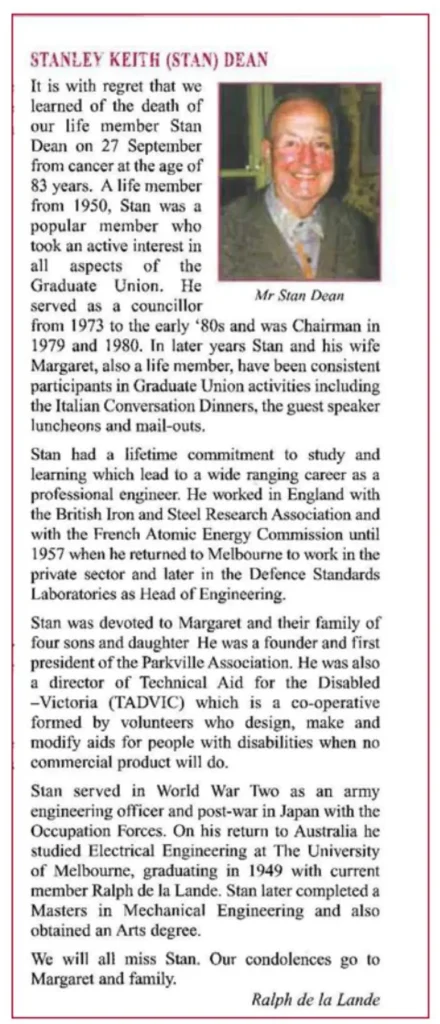
Stanley Keith (Stan) Dean
Our Founder Stan became more closely involved with Parkville when, with some neighbours, he persuaded the Melbourne City Council to plant kerb grass and later trees on a large part of the wide asphalted area of levers Reserve that separated the rear fences of two streets. It was fast becoming a defacto hospital carpark. This created a safe play area for children and a congenial place for street parties. Many years later, a seat would be placed under the trees to commemorate Stan’s contribution to Parkville.
The years 1967 till 1970 were dominated by two major attempts by the Hospitals and Charities Commission to demolish large areas of Parkville in order to relocate University High school and then use its land for the expansion of the Royal Melbourne Hospital. The immediate reaction was the formation of the Parkville Association, of which Stan was co-founder and first President for 12 years. The battles were finally won, but not before they reached State Government level. In order to discourage further attempts, the Association decided to prepare a submission to the National Trust to classify the area. This submission was accepted and so South Parkville became the first urban area in Australia to receive National Trust classification. The submission was later edited by Hilary Lewis and published by the Association as a hardback (Lewis, Hillary, South Parkville, 2nd edition, 1996) available at the Parkville Post Office.
Parkville past present future
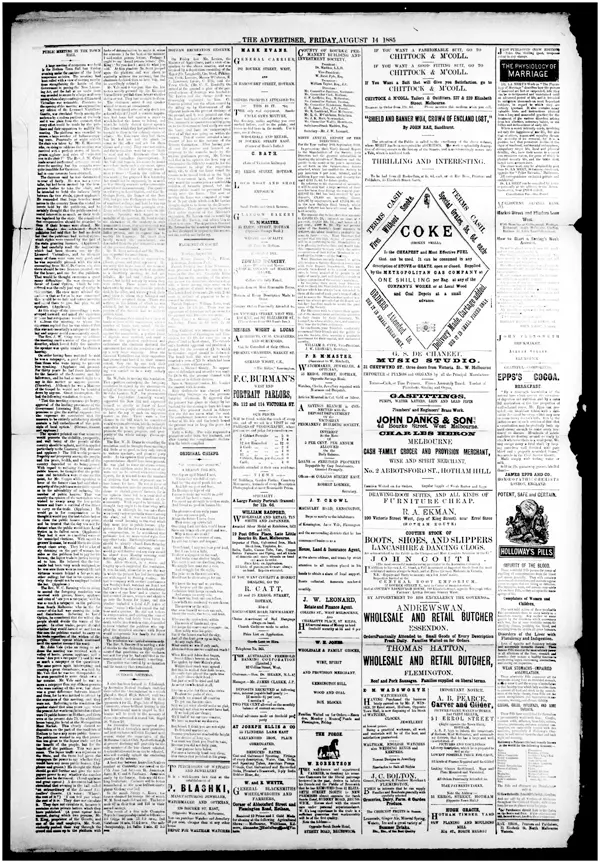
North Melbourne Advertiser 14 August 1885, page 3
The following paper was read by Mr. D. Scott at a late meeting of the Parkville Debating Society as the subject is of local interest we give our readers the paper in extenso. Mr. Scott said:
Parkville or Royal Park as it was originally called is a suburb of but recent growth. A few remarks on the subject may be of interest to our audience. In 1870 there was not a house between the Haymarket and the Sarah Sands with the exception of the pound-keeper, Mr. Falstead’s and which is still in a good state of preservation in Morrah-street, Carlton Cricket Club pavilion and the residences of the people employed at the Acclimatization gardens and the Royal Park. Parkville proper, if I may so call it, is where the Port Phillip Agricultural Society held their shows. It was little thought at that time that we would be assembled in this building, on the opposite corner to where we are now was the dog pound, the remark ‘going to the dogs’ does not apply to the residents of Parkville however, as the dogs have gone from us to the sweet savoury Yarra.
Read full article in PDF
Parkville Post Office a brief history
The first sub-division which began the establishment of south Parkville occurred in 1872. This subdivision created the east-west streets of Morrah, Bayles and Degraves, and the north-south streets of Fitzgibbons and Wimble. In 1879, further subdivision and sale of land occurred in the suburb between Morrah Street, the newly named Story Street and along Park Street. Gatehouse Street was also formed by 1879, with a wide median between it and Park Street, known as Ievers Reserve, now Redpath Rise, allowing for the channelling of the creek bed that ran parallel to the two streets. The majority of dwellings in Parkville were erected between the early 1870s and early 1890s.
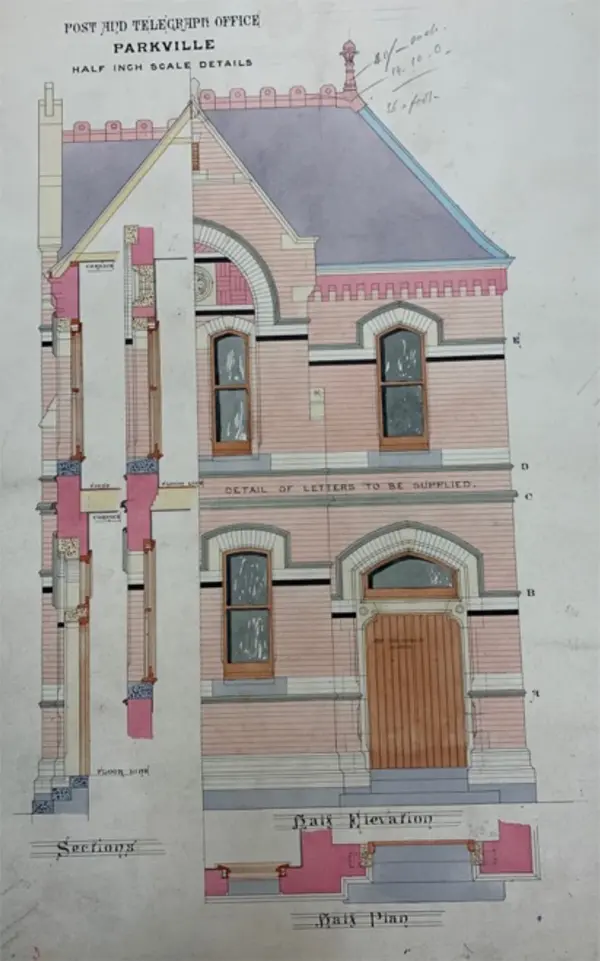
By the early 1880s, however, it was clear that the suburb was developing. In 1883 the government sought to establish a Post and Telegraph Office in Parkville.
Read full article in PDF